
In this Winter season, of course I’m talking about Winter climbing–Ice climbing. I started climbing ice in the early 1970s. The equipment available was varied and experimental at that time, but all very crude by today’s standards. As well as seeing a lot of of ideas in magazines, we aspiring ice climbers quickly found ample opportunity to change techniques and invent likely improvements to our available equipment, and we even imagined variants to the state-of-the-art gear that we saw and heard about — with their reported growing pains. The main areas of focus quickly led to shorter ice axes with drooped picks, rigid crampons, and practical pitons and screws for protection. Techniques also evolved along the way — largely in step with the changing equipment.
My purpose in this article is to review the strides made in ice climbing equipment and techniques and enjoyed by current climbers — except for one glaring area that has been left behind.
_____________________________________________________
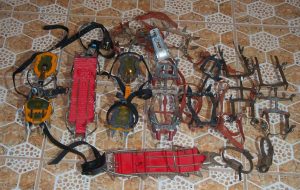
Crampons underwent several oscillations of style between rigid and flexible types, variants with single front points, vertical points, heel spurs and hooks, and cramponed boots, but finally got the least radical overall improvements, so that now it seems that nearly ‘anything will work’ as crampons, collaborating with stiff, if not rigid, boots.
 Ice screws received a lot of design attention over the years because of their ultimate importance in safety, especially since the (steepest) places where they were most advisable were exactly the places where they were most awkward to install while hanging on for dear life. Ice pitons and sharp tubular pound-ins were tried for a few years but eventually abandoned because they all took a huge toll of energy to put in. Design attention shifted to improvements in screws to facilitate their penetration of solid ice. Variants with sharp teeth, more teeth, and slick coatings were tried, while retaining strong tubes. Also stepped and tapered tubes were tried, to ease ice ejection, including during insertion. Naturally, at first it was generally thought that a beefy thread was necessary for pull-out strength, but that was eventually shown to be unimportant, while requiring great torque to turn in through the ice. Eventually good design and metals, and precise machining produced screws with thinner tubes and fine threads at lower pitch, all with a smooth finish, plus cranks, that go in with very little effort, yet have high strength against both sideways/downward and straight-out forces.
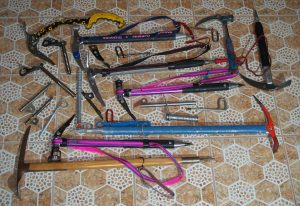 Technical ice axes became known as tools, and improved quite quickly through many stages with various hooked or tubular picks, kinked shafts, hand and finger ledges, leashes of many kinds to hold tired hands on the steep shafts, curved shafts, combinations with adzes and hammers, and finally curved shafts plus kinks to make them leashless, and some doing away with adzes and hammers entirely. The present state of the art in ice tools is leashless with a kinked-back built-in handle in a curved shaft, and a hooked, drooped chisel pick.
The “leashless” aspect was a puzzle to most people for some time, including me, and likely still IS: ‘going leashless’ sounded good in a way because the leashes (also called wrist loops) had to be ‘dealt with’ continually — they were a nuisance, but at the same time they were NEEDED to help us to hold on to the tools, and also served to prevent dropping them. Occasionally they were also clipped in to, as an anchor — often in a panic. Many arrangements of clips and sliding loops were devised, even commercially, to facilitate disconnecting and reconnecting with the tools. The arrival of ‘leashless’ tools was quickly welcomed, but many climbers didn’t realize that they not only HAD no leashes, but didn’t NEED them: their secret was the handles or even just ‘kinks’ that were angled-back just enough to act like monkey-bars, so your hands didn’t tend to slide down the handle. Most of the hand effort and fatigue in climbing with ‘leash’ tools resulted from GRIPPING the shafts to prevent sliding, while just ‘hanging’ itself was relatively easy.
Of course, climbers absorbed all these improvements casually as if they were entitled to them and had actually become ‘better’ climbers, without any mention of the tremendous technical innovations that they inherited, or awareness of the difficulties, miseries, and herculean efforts involved in the early first ascents and even followup climbs of the first twenty years. Climbers used to camp in the gullies to give them the most time ‘next day’ to do the next couple of pitches — wondering when an avalanche might come down; every screw was very tough to get started, and then had to be forced in to cold ice with the use of a tool through its eye as a lever. Even the screeching of the screw against the cracking ice was awe-inspiring, but an experience withheld from current ice climbers.
Less-key advances were made in many other aspects of climbing gear, techniques, and clothing. The massive
early helmets were trimmed and lightened with the realization that although the need for head protection seems undeniable, it’s a bit discretionary, as no one knows just What kind of knock they might get; some eventual designs eliminated the shell, leaving only the foam padding as a helmet — very light, but…?
Some harnesses claiming specialization for ice climbing appeared, but gained little applause as such because whatever available harness would do for ice climbing, even with some easy modification if wanted.
Handwear for ice climbing has always been a problem for the obvious reason that fingers are delicate! — they get cold the worst, especially up in the air with less blood circulation allowed by gripping the tools. Mitts, generally used at first, gave much way to gloves for dexterity, as good gloves became available, especially with insulated box fingers, and of course later, electric heating. Various advice and glove technique was also offered along the way, including changes of gloves and even the great importance of delicate hand control (?), and so several pairs of very light gloves to change at every belay and so be ‘half-frozen’ all the time!
A branch of ice climbing call “mixed” developed by moving on to rock for access to hanging ice formations, or alongside or alternating with sections of ice, and even entirely on rock where it claimed its own identity as a separate sport called “dry-tooling”.
In techniques, many gimmicks were invented, mainly to give instructors more material to teach and demonstrate on ice-climbing courses, and add spice to the sport: various insistent cadences of foot and tool movements in ‘progression’, obsessive swapping of tools, with hanging tools over the shoulders meanwhile, heel hooks, crossing arms, figure-4 maneuvers, etc. have been taught and later mentioned, but with some skepticism among regular climbers: most weekend-warrior climbers quickly learn and adopt equipment and methods that work for them, and those tend to be practical, ie., the simplest.
This all gives you a good idea of the great amount of innovation that has happened in the first 60 years and is enjoyed routinely in modern ice climbing to make it easier, more secure, and overall safer.
But an incomprehensible gap remains — in the backward conventional technique still used, recommended, and taught by hotshots, guides, and instructors for resting and placing protection.
Next month I’ll discuss UMBILICALS in some detail, as they are a terrific but misunderstood and generally shunned source of reassurance and safety in ice climbing.
Orvel



0 Comments
Leave a reply
You must be logged in to post a comment.