
Ice climbers of these latest 20 years have been privileged to have ready access to highly developed versions of most of the equipment, including screws that easily spin in, but they are still always awkward to start with one hand while holding on to one tool with the other, in the primitive technique of protection still universally used and taught by guides, instructors, and hotshots. They commonly also frown on the use of umbilicals, even for tool retention: “A decent climber will never drop a tool.” – a silly suggestion.
I find it quite unbelievable how climbers have continually snapped up advanced equipment as it appeared through the years, but still accept being bullied by the ancient norm of the technique for resting and placing protection, while a superior modern technique is also available.
Stretchy commercial umbilicals have long been produced — though apologetically, with weak attachments — recognizing the importance of not losing a tool in the middle of a climb or dropping it on your partners. But of course ‘those elastic umbilicals can never be used for supporting the climber’s weight in any way!’ – apparently a no-no.
But many climbers also began to quietly make and use their own stretchy umbilicals, but with bungee cords inside strong tubular webbing, with carabiners or quick links to allow for ’emergency’ personal support — a clear creepage of ‘ethics’ in the taboo direction of personal security.
When I started ice-climbing, way back in the 70s, one of the first things I noticed was the obvious awkwardness of dealing with ice tools while working on protection and other equipment: “what to do with the axes when not actually climbing?” — those early tools took more effort to plant so that they were ‘solid’, so they often flopped over sideways and fell out. Obviously they should be tied in to prevent dropping and possible loss of the tool, and by just looking around ‘our world’, we find that workers in high places wisely secure their tools against droppage, with cords. So that’s a no-brainer in ice climbing.
But at the same time it was clear that such a sling could also be used, and even important, for extra security in awkward places — ie., for ‘us’, and so it became known as an umbilical. The anatomic imagery is quite valid, as the tool was always secure to the climber, and also the climber could at times be connected for security to (perhaps) ‘Mother Ice’, but “umbilical” became a term of derision, as a tough climber shouldn’t need to be ‘tied to Mama’.
Because of the usefulness and even importance of umbilicals, slings of different kinds, prusiks, and daisy chains were tried in many ways from the earliest days of ice climbing – in the ‘60s — including for direct progress by stepping up on a loop attached to an axe, likely because of the insecureness of the early (mountaineering) crampons available. That application appeared to be “direct aid” because of its similarity to the use of etriers (rope ladders) on pitons or chocks as ‘Aid’ in rock climbing.

Early Tool with Rung Ladder
Aid was generally frowned upon, except for otherwise-impossible problems, where the practicioners were implicitly excused as being on ‘another plane’, but the technique was awkward and tedious in ice climbing, so it never gained much acceptance there anyway, especially when better crampons and tools were developed. Still, the association of the attachment sling with aid was established, and the word “umbilical” stuck, along with its negative implication.
However, from the start in the mid-70s, I was intent on making ice climbing as safe and also as enjoyable as possible. I realized that ALL of ice climbing is Direct Aid, so any pretense of superiority by restrictions on techniques of resting and placing protection was ridiculous. All climbers are allowed to rest, so ‘tolerant’ instructors permit it, but still, ‘the ice climber Must put in a screw FIRST’, then clip a quick-draw to it, and hang ignominiously from his waist, with his butt sticking out.

Conventional Rest Position
That looks bad, but after all, he should have been ‘able’ to climb the whole pitch without resting, shouldn’t he? … AND will eventually BECOME able to – after taking a few more cour$e$ !
NOPE! — not for me. I immediately saw several backward aspects of the ‘conventional’ techniques that could be improved at once — with umbilicals:
First of all, security with ice tools is a ‘two-handed’ technique: You HAVE two hands and two tools, yet the legacy technique calls for hanging off one tool to free the other hand for placing protection; the other tool is left in the ice to one side, useless and preferably untethered. I saw quite a few tools dropped that way.
Second, installing an ice screw is also a two-handed operation: we don’t have swivels in our wrists, but the conventional ‘old’ technique calls for using one hand: maybe start a hole with the ‘spare’ tool, then twist the screw back and forth in it with that one hand, to catch ’just enough’ that it might not fall out while letting go of it briefly to reset your hand and continue starting the screw into the ice until it’s solid enough to withstand cranking. I’ve seen Many screws dropped that way – by jittery climbers struggling to hang on with one hand while fumbling a screw with the other, and wiggling their only support tool to pop out while they’re absorbed in the protection.
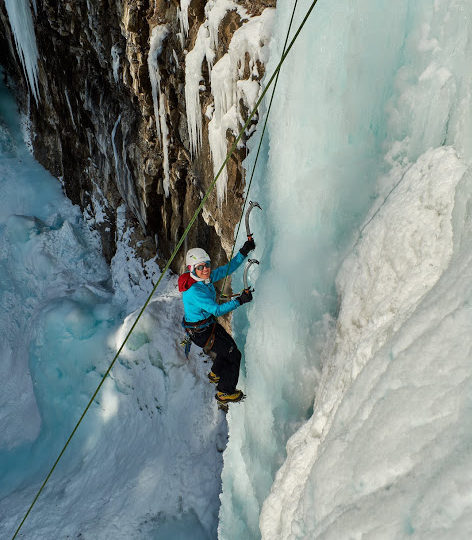
Umbilicals can solve both problems at once: place both tools solid above you, and settle back on the umbilicals to free BOTH of your hands for placing protection. The umbilicals hold typically about 1/3 of your weight, with the rest on your crampons. You rest with Full security (both tools) while placing protection, but the umbilicals aren’t even used for ‘progress’ (as tools and crampons normally ARE), so quashing any possible criticism of bad ‘ethics’ by aid.
Furthermore, your vertical posture during all this is relaxed and dignified, so anyone watching may not even be aware that you’re resting while putting in protection — you’re just taking a break.
Third, you MAY, and if you run out of screws, you actually CAN belay a following partner off your tools and umbilicals.
Fourth, you can use the tools and umbilicals for security in trees or rock, etc. ‘at the top’ while setting up a more-complex anchor.

Early Tool with Attempted Adjustment
Early-days on-the-spot, emergency or experimental umbilicals were a variety from simple slings, thru daisy chains, etriers, and even prusik loops tied in knots every few inches: climbers clipped in where they could or tied knots in the ‘right places’ to hold themselves in position while resting or placing protection. Those places were NEVER RIGHT! – always a bit too high or too low, so using the tools for handless security was awkward and seemed just… unworkable: continuous and easy adjustment was needed, to get it ‘just right’.

80s Tools with Leashes and Adj. Umbilicals
I tried a few continuous adjustment methods with both cord and tubular or flat webbing, using prusiks, tablar buckles, and D- or O-rings. Flat straps through round rings worked the best, but none were very easy to adjust, even when dry, and all got a lot worse or impossible when typically coated in snow and slush. But still, the overall idea was right, and worked to a certain extent. It just needed a better device, that could be adjusted, and easily, with one hand.
Eventually I tried the idea of the traditional tent-guyline tightener, just scaled up: a metal plate with two holes in it, on a cord loop, and this turned out to make the perfect adjustable umbilical lock with a metre of single 5-7mm cord. I put a bend in the plate to increase the locking effect on the cord, and called it a Kinky, then added various refinements for ‘preshortening’ in cases where a tool has to be placed closer than half of the cord length from you. I increased the slider hole to eliminate friction of ice build-up, but still have never had one slip. These are easy to make at home and are a bit like (I hate to say) an advanced version of Purcell Prusik.

Magic Kinky Device
These simple magic umbilicals unclench your stomach, and will turn you into Climbzilla after a little practice for familiarization and reassurance that they work – they DO. That took me some time too – no one likes to trust their weight to the tools, although that’s what they do all the time anyway, except with their hands! It’s easy to practice on a top rope or simply while following and nobody even knowing what you’re up to – just make sure it’s vertical, so you can’t fudge it by sidestepping THESE umbilicals while seconding: Just TRY putting in (OR out) screws on vertical ice with the current pathetic ‘standard’ method, and you immediately see the power of this one. It’s not hypothetical: I and a few friends have used it comfortably for 20-30 years, occasionally having nearby climbers take a sudden interest in the system after falling off or dropping gear. A few others have ‘had’ these umbilicals for some time but never got comfortable with them – either satisfied to follow difficult pitches (and awkwardly), OR never having pursued the nervey initiation to hanging off their tools by cords, OR leading vertical.

Magic Umbilical
CLIMBERS! — If you want to keep ice climbing difficult, scarey, miserable, and dangerous for yourself, follow the advice of instructors about umbilicals: “Get rid of them!” and you’ll fulfill that goal for sure… unless you’re that 1% who are stubborn hotshot material who ‘can’ make do without them, but eventually scare themselves silly and go sea-kayaking. But EVERYONE should use umbilicals, and will benefit from them, and really enjoy climbing ice for the first time, as everyone has only 2 hands with no wrist-swivels, DOES drop things from time to time, and occasionally needs a rest: We are ALL only human.
With these Magic umbilicals, any ordinary climber (and YOU) can become a confident CHAINSAW of ice climbing, and a 456 leader, and enjoy it with only the objective problems remaining – those are serious enough, you don’t need to create more for yourself. You can make these devices yourself, or enlist a friend, or see or call me. They’re worth as much as your tools.
Orvel



0 Comments
Leave a reply
You must be logged in to post a comment.